Throughout my career across multiple industries, I’ve had the privilege of negotiating and managing partnerships with some of the world’s most recognizable brands and elite athletes. My work has spanned collaborations with many heavyweights, including Hawaiian Airlines™, Nike™, The Price is Right™, the Daytona 500™, and several world champions across surf, snow, wind, and wake/waterski sports. These engagements sharpened my ability to understand brands at a deep level, how they think, what they value, and how to position a product or idea so it resonates with both executives and consumers. They also equipped me with the creative, strategic, and operational discipline required to deliver results in high-visibility, high-stakes environments.
I’ve listed the brands I’ve worked with in chronological order, beginning with the first brand I ever went after, Nike ACG™. For the most recent partnerships, scroll to the bottom of this page.
For a visual snapshot of my career path, visit my résumé page.
For a graphical view of my career timeline, visit my resume page.
___________________________________________________

After submitting my first video game treatment, "Surfer's Paradise," to the Library of Congress in 2000 to secure a copyright, and finding Stewart Apelzin (of Myst fame) as a mentor, I targeted Nike's outdoor-focused brand, ACG™, for involvement in the game. Despite having no prior experience engaging with brands beyond being a consumer, I thought, "Why not start at the top and speak directly with nike™?" Knowing that ACG was a long shot, I captured their attention by sending a mid-sized box of sand with a see-through bubble top, featuring a surfing beach scene in a mailable diorama. This creative approach got me into the room, and subsequently, ACG agreed to be featured in the game and to become a sponsor.

After getting ACG onboard, the next target we focused on was Hawaiian Airlines™. The goal was to gather a ring of surf-themed brands around the game, trading exposure in the game for coordinated promotions. Promotions included custom apparel, trip giveaways, and cooperative advertising across media channels. The meeting with Hawaiian went very well, which wasn't a surprise. Our initial pitch was we only wanted to take advantage of their empty seats, and it went great from there. While in Honolulu we took the opportunity to meet with Outrigger Hotels (also a successful outcome), and to visit and surf the "Power Plant" break south of Makaha. I wish I had space here for that whole story, but just picture a haole surfer from Oregon renting a board and diving in with the locals on Oahu's notorious "West Side." I had read about notorious localism in this area, but decided to go anyways figuring, "If I'm just respectful..." As it turned out I paddled far outside the break and simply observed for a while, making myself shark bait. After 30 minutes a local waved me in, intros were done, and all was cool. They were glad I didn't just "charge it." And as it turns out their respect for us NW surfers is pretty high, due to our apparent swimming with great whites! :) Not that we all don't know about the sharks in the water here. We just shrug it off with lottery/lightning strike comparisons and trust our sixth sense. In any case, the surf was (at best) mediocre, but the locals were beyond cool. Our first meeting with legendary big wave rider Ken Bradshaw and seven-time Female World Champion of Surfing Layne Beachley also took place on this first trip to the islands (see ATHLETES).

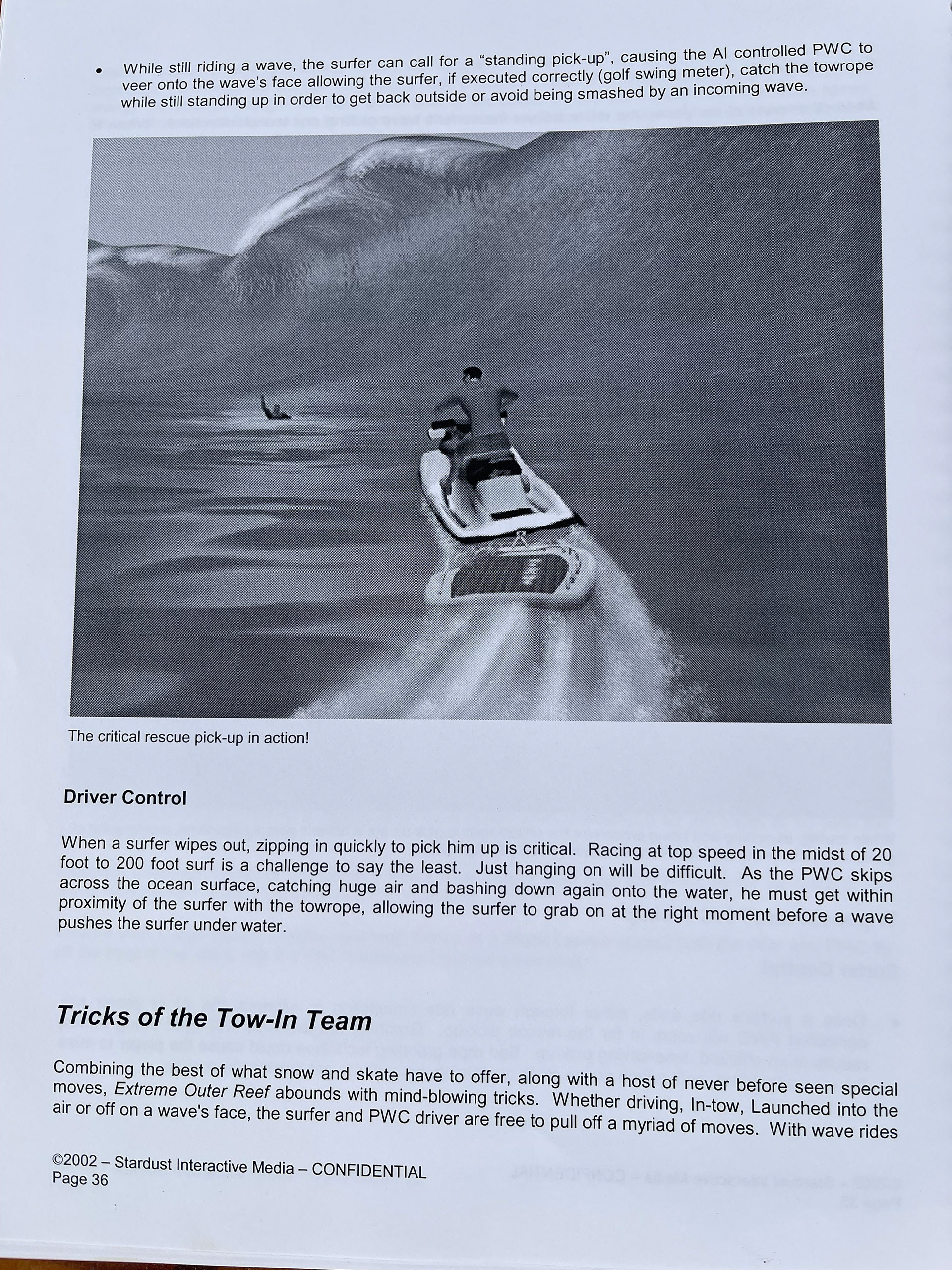
This is just a small bit of the game treatment for what had become 'Extreme Outer Reef.' I featured it here because it jumps right into the guts of what made the concept heart-pounding. Nothing like screaming into the path of an oncoming tidal wave to rescue your buddy (or get rescued yourself!). Brian Keaulana's character is driving the ski here, heading in to rescue Ken Bradshaw. See more in VIDEO GAMES.
Boasting one of the coolest hotel names and owning a long list of tropical resorts and hotels across the world, Outrigger appeared to be an ideal partner for Surfer's Paradise. Already working closely with Hawaiian Air on other promotions, we figured if we could get Hawaiian on board first, then Outrigger might appreciate this in our meeting.  So, the day after meeting with Hawaiian Air we met with Outrigger. Being able to share our success with Hawaiian Air certainly didn't hurt, and Outrigger signed on to become part of the growing collective. The company committed to providing prize packages and promotional support for the game, just as hoped.
After the great trip to Honolulu, we decided we needed a beach-themed clothing brand that could set the spirit of the game. To be sure we didn't expect Tommy Bahama's main target (affluent, middle-aged+ men) to be playing our video game. Yet the island cool factor of the brand lent itself to a degree of authenticity, going beyond the typical, target market-tied brands. We weren't going for the L.L. Bean kind of thing, but even gamers could relate to the jungle vibe and relaxing focus of Tommy Bahama's adventurish clothing. Boasting strong distribution, and trending at this time, we pushed for a meeting. We got in the door, and Tommy Bahama showed immediate interest. They agreed to contribute to the consumer prize packages and promotions. The cherry on top was their commitment to create a custom "Surfer's Paradise" Hawaiian shirt for general sale and to promote the game.

After getting Tommy Bahama on board, it was time to head to LA to engage with a prominent mainland surf brand. With our strong momentum established in Hawaii and connections with top surf athletes, we were eager to tap into the mainland US market. Securing a meeting with the renowned Santa Barbara surf brand Channel Islands Surfboards™, led by founder Al Merrick himself, was a major win. We were met with enthusiasm, and Channel Islands decided to join our portfolio of brands, offering surfboards and additional marketing support in exchange for exposure in the game.

While we had Nike ACG on board, we wanted another clothing brand that targeted a different buyer, specifically one with a "super edgy surf/skate" vibe, embodying aspects of California skate counterculture. During this trip, we met with and signed Counter Culture Clothing Co.™, who agreed to create custom wear and join the other sponsors.
While working closely with Ken Bradshaw (see athletes) on the Extreme Outer Reef video game, I had the chance to assist him in creating Billabong's film Odyssey, a documentary covering the quest of several of the world's best big wave riders to find and ride a 100-foot wave. Through this project, I met and hung out with a multitude of big wave talent, including the incredibly cool Shane Dorian.
Odyssey aimed to find the world's biggest waves. After studying historical data, it was determined that a great place to find giant surf in the winter was, incredibly, the Columbia River Bar, right here in Oregon/Washington. Since I lived in Portland at the time, I was perfectly positioned to help. One of the coolest things that happened during all of this—beyond taking Ken to my favorite local surf breaks and watching locals freak out at his mastery—was when I introduced Ken to the Coast Guard at Cape Disappointment, WA.
After picking Ken up at PDX one day, we drove down to the motor lifeboat station and just walked in. Ken began asking about taking a PWC out at the mouth of the Columbia River in extra-large surf. We were swiftly told that was "impossible," with a young ensign noting that when the surf is up, small craft are barred from crossing the bar.
Not wanting to name-drop or talk about his credentials as a member of the North Shore Water Patrol—the top surf rescue outfit in the world—or his world record for the biggest wave ever ridden, we were suddenly fortunate when another young Coast Guard member recognized Ken. We were swiftly ushered into the captain's office, and a video of Ken's world-record-breaking 85-foot wave ride was quickly on the screen. Minds were blown and, in short order, Ken negotiated a trade with the Coast Guard: permission for him and other top big wave surfers and rescue practitioners to access the Columbia River bar in high surf conditions in exchange for putting on a surf rescue clinic for the Coast Guard and the Long Beach, WA, Fire Department. Now, the initial experts would learn from the best in the world. Fair deal, I say.
This completed our round-up of brands involved in Surfer's Paradise, which was later retitled 'Extreme Outer Reef' after securing a publishing deal as an Xbox launch title. For more details on what happened with the game regarding publishing, see the full story in Video Games.
Fortunately, as the Extreme Outer Reef chapter came to a close, I was onto another invention: the WakeKite. A wild fusion of kiteboarding and wakeboarding/waterskiing, you can read more about the story of WakeKite on the Inventions and Patents page. Here, you'll find some extras detailing the many top brands I worked with in promoting this new sport.

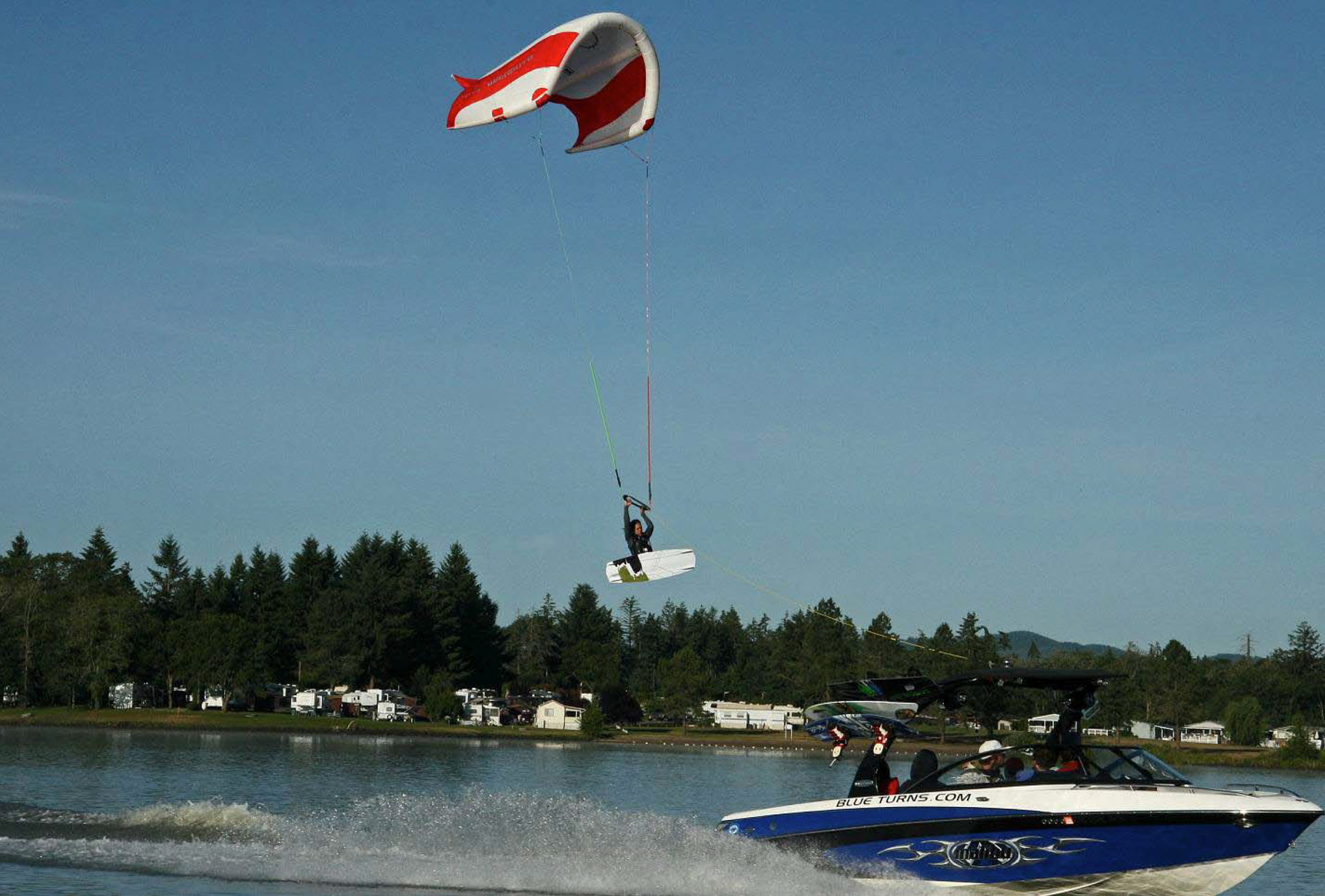
Team WakeKite rider Kedzie Gunderson at the apex point after a gigantic jump on Fern Ridge Reservoir, Oregon, circa 2009. She covered over 200 feet of distance on this one, landing like a feather.
When I first began inventing the WakeKite, I used off-the-shelf hardware, random sporting gear, and modified kiteboarding and regular kite equipment to build testable prototypes on land. I can't tell you how many rolls of duct tape I went through, or darn near lost a finger due to sudden wind and tangled lines. In any case, after experiencing some success on a particularly windy day near the Portland Airport, I decided it was time to contact a commercial kite engineer to help me take steps toward having the kite float on water and consider manufacturability.
I reached out to North Kiteboarding in Hood River, Oregon, and met with Ken Winner, their lead kite designer and a well-known figure in the kiteboarding community. Despite some initial skepticism—since we were introducing gasoline engines (boats) into the traditionally wind-driven sport of kiteboarding—Ken was intrigued and challenged by the concept, which secured his interest. Ken ended up building six prototype kites for us, each one getting us a little closer and a little more stable.
While we made some progress together, Ken was very busy with North Kiteboarding. He graciously introduced me to Corwin Hardham, a recent Stanford PhD engineering graduate from Hood River who also loved kiteboarding. Corwin, along with another inductee, Joe Van Niekerk, another Stanford PhD, helped me develop the WakeKite into a demonstrable water kite that once unveiled at a "top-secret" demo on Lake Merwin, Wa. in 2006, blew the socks off of HO Sports and led to our fast buyout. Joe then joined me at HO for the next six years where I functioned as Global Brand Manager.

In the quest to invent and build the WakeKite, I always knew that I would be entering into a world of powerful brands, athletes, events, and rules. With the WakeKite being pretty bombastic, risky, and way outside the box, I knew we'd be "up against it." Of course, with most things being political, I also knew that getting key partners behind the project would likely be the only way it could succeed. We needed muscle, both in distribution and promotion, but also in legal. Thus, after securing our patent, which hinged upon a safety release system we built for the handle, we went to the very top and met with HO Sports, Inc.™, the biggest wakeboarding/waterski brand on the planet. Interestingly, David Howitt (of The Meriwether Group) arranged this meeting (thanks David!). Impressed at the historic Kitty Hawk-like demo we did for them on Lake Merwin in the late winter of 2006, HO bought WakeKite lock-stock-and-barrel and appointed me into the position of global brand manager for the line. This was very cool indeed.
As the Global Brand Manager for WakeKite at HO Sports™, Inc., I negotiated a lot of exposure and demo deals to get the kite noticed. Below are a few of the brands I (we) engaged with and some of the brief stories behind them.

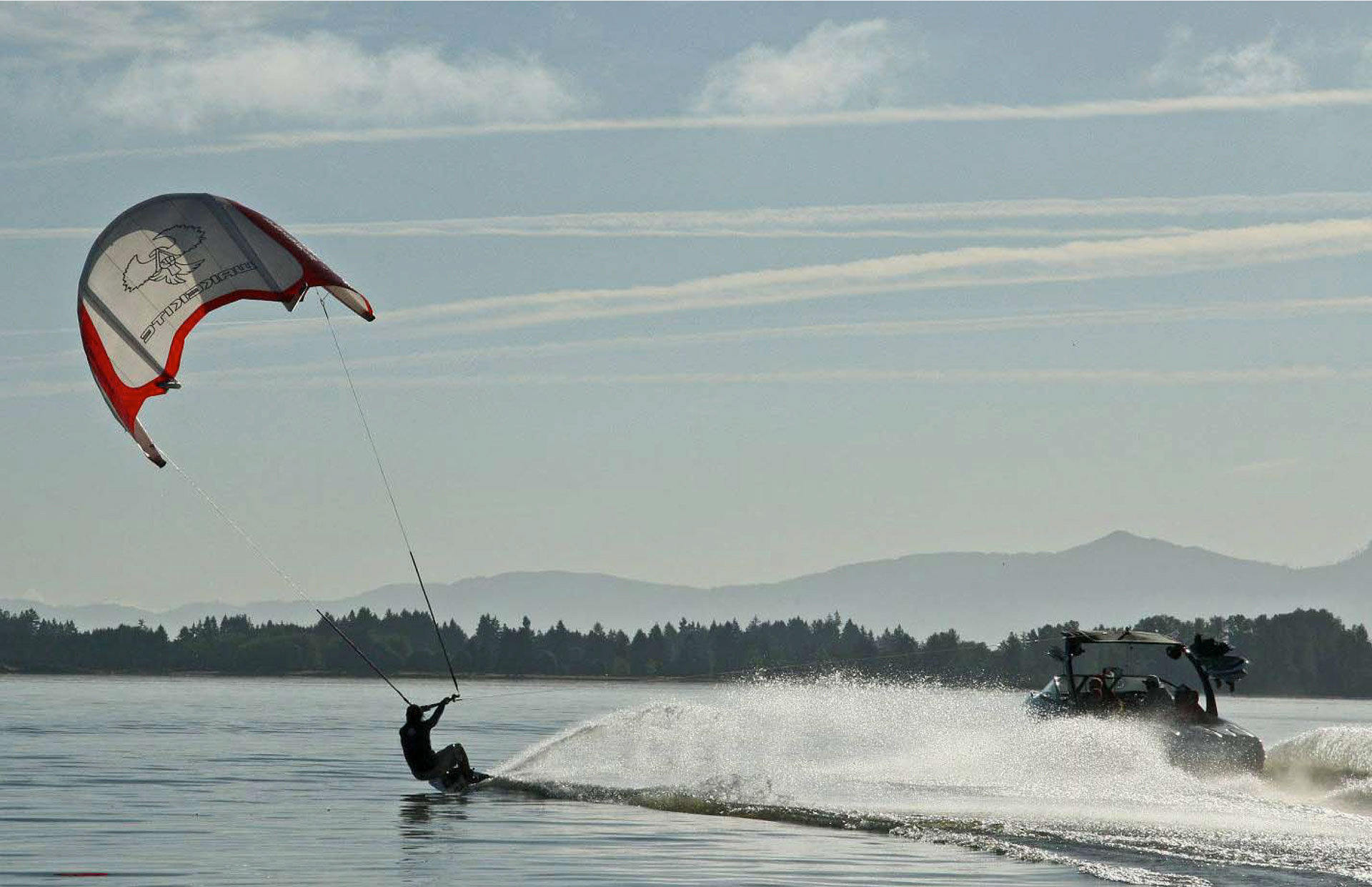
This picture was shot on Tamarack Lake south of McCall, Idaho. We were there for a video shoot and to introduce the sport to some local dealers. The water, wind, and light were perfect during this early morning session. Here team rider Ben Noble cuts outside, getting ready to release the kite back to center for a jump approach. Funny as it is, when later testing out on Payette Lake in McCall, Adolphus Busch (of Anheiser-Busch) chased us down in his speedboat and kept flipping hundred dollar bills at us until we finally agreed to sell him one of our test kites.
As the brand manager for HO, one of my initial responsibilities was to engage with regulatory agencies across the country regarding the WakeKite, an extreme sports equipment package intended for use on local lakes and rivers by consumers. Among the first agencies I approached was the U.S. Coast Guard™. To garner their support for WakeKite, I conducted a live demonstration for a gathering of Coast Guard officials in San Diego. This demonstration led to an endorsement from the Coast Guard, as they were impressed by the safety features integrated into the kite system.
Following our successful engagement with the Coast Guard, my next step in gaining approval for WakeKite on local lakes was meeting with the National Association of State Boating Law Administrators (NASBLA™). Over the span of a year, I held numerous meetings with NASBLA officials. These efforts resulted not only in securing their endorsement but also in their active participation in lobbying for the kite's use on larger private lakes.

Securing support from organizations like the U.S. National Park Service™ was crucial for WakeKite's acceptance. With many large bodies of water under their governance, it was essential for them to recognize and understand WakeKite to prevent confusion among consumers and park officials. Through multiple meetings, we highlighted the safety features of WakeKite. This effort became even more vital when a dangerous product, the Wego Kite Tube, emerged around the same time, causing serious injuries. By distinguishing WakeKite from the Wego, we aided agencies like the U.S. National Park Service, Coast Guard, and NASBLA in making informed decisions, ultimately preventing bans on WakeKite despite restrictions on the Wego Kite Tube.
Promoting the novel WakeKite was a primary objective during my tenure as Global Brand Manager at HO Sports. Given the limited size of the product line, and consequently, our budget, I needed to identify high-exposure opportunities with minimal or no cost. Recognizing the potential of WakeKite as a captivating item, I pitched it as a "Showcase Showdown" feature on The Price is Right™. Determined to make it happen, I persisted in reaching out to the show until I discovered the application process. Months later, I succeeded in getting the kite featured on the show and had the opportunity to hang out with Drew Carey backstage, with the added bonus of having my mom and her great-friend Sally Struthers accompany me. All in the Family anyone? The WakeKite's appearance in the Showcase Showdown led to an uptick in sales and greater acceptance at the regulatory level.
When race season kicked in in 2008, I worked with the Daytona 500™ to allow us to hold an exposition during the live race, utilizing the lake at the center of the track. On the day of the event, gusty winds resulted in some big-time jumps, hats off to Ben, Raleigh, and Kedzie. The team had the unique opportunity to sign the Daytona checkerboard finish line after the race. Catch a glimpse of this action in the WakeKite video featured on the Inventions and Patents page.
As the brand manager for WakeKite, Surf Expo in Orlando represented one of our largest exposure opportunities each year. We'd build a spacious booth adjacent to HO Sports' expansive setup. Inside, we crafted a lounge atmosphere complete with couches, videos, equipment showcases, and professional athletes available to talk about the kite system. Surf Expo primarily targeted prospective buyers interested in stocking our product. Additionally, we conducted offsite demonstrations for crucial dealers and athletes. Our presence at the show remained consistent for six consecutive years. Pro team riders Ben Noble, Kedzie Gunderson, and Raleigh Murch made these "Surf Expo Days" some of the most memorable in the WakeKite journey.
Hyperlite remains the leading wakeboarding brand worldwide, excelling in athlete sponsorship, distribution, and trendsetting. As a brand under HO Sports, Hyperlite's foundation has been meticulously built over decades. When I served as the brand manager for WakeKite, I gained access to Hyperlite's robust marketing infrastructure, renowned athletes, and extensive network. This support from Hyperlite opened numerous opportunities and facilitated several exciting events.
Greg Ashton, then the VP of Engineering at HO Sports (now at Amazon), played a crucial role in supporting the WakeKite team with his expertise in manufacturing. Greg not only provided invaluable assistance but also became a great friend. He is a total class act. Another key figure at HO Sports was Greg Dick, their VP of Marketing. I learned a tremendous amount from Greg D. about brand management and promotion. Tim Joyce, then President of HO Sports, Inc., was also instrumental in WakeKite's asset purchase in 2006. Tim, a former NBA player with the Cleveland Cavaliers, saw the value in WakeKite and pushed to make it happen. Finally, CJ Vlahovich, HO's VP of Sales, was also a key figure, along with a long list of amazing account reps, including Rick Skinner, Scott Sims, and Eddie Beverly: All three of these guys were amazing, total pros, and great to be around.

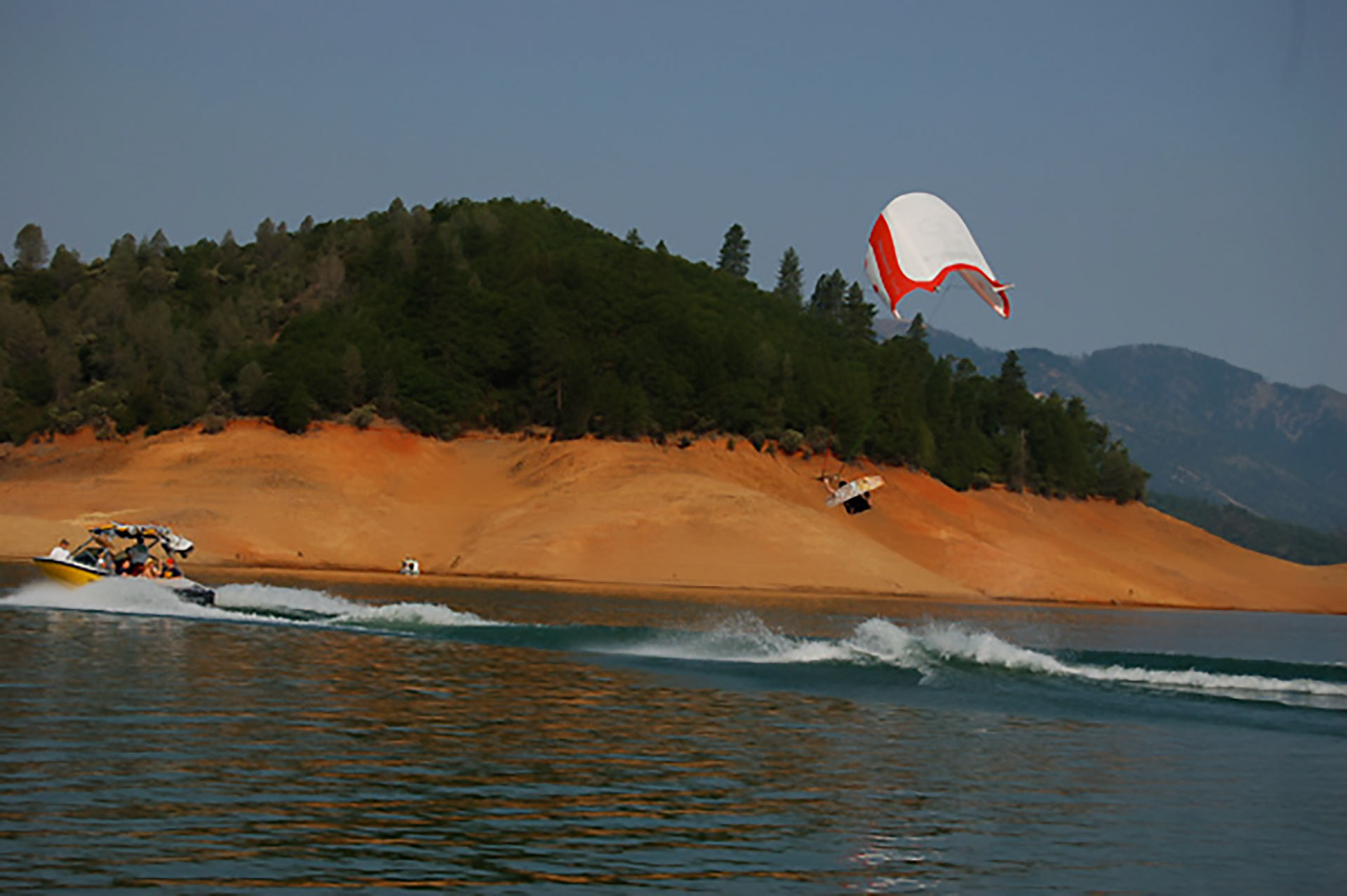
Rider Raleigh Murch going big on the WakeKite at Lake Shasta, 2008.
Testing Makes a Spark
One afternoon we were testing a new version of the WakeKite on the Willamette River. After witnessing a rider's particularly high jump, Joe Van Niekerk, the lead engineer for WakeKite, exclaimed, "Man, I bet we could build a device to measure that air." This comment sparked an energetic discussion between us, leading me to develop a presentation for the HO Sports' board of directors. 

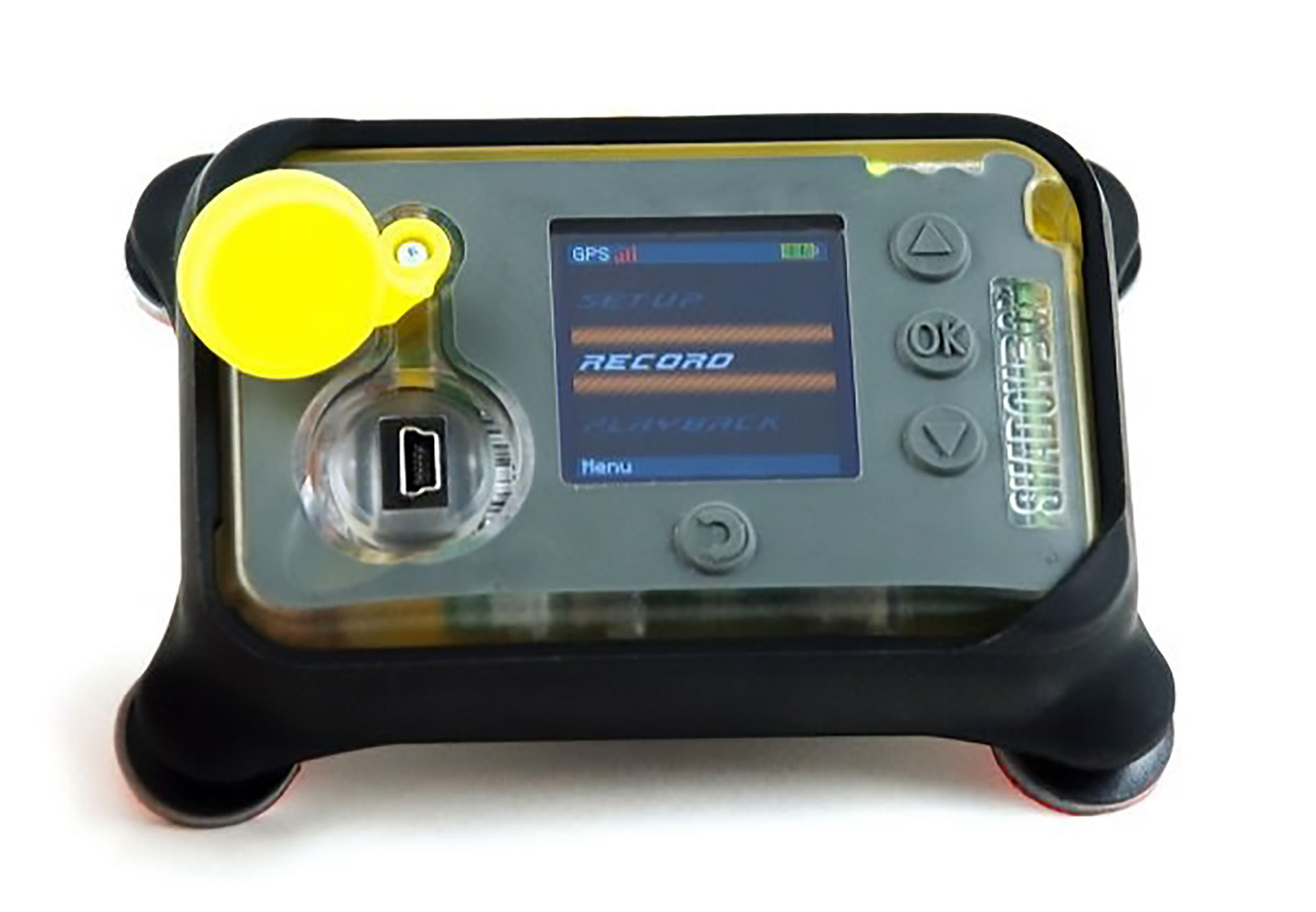
The ShadowBox 3D Sports Recorder. Physics "dope" in a rugged, waterproof box. Only the sky was the limit. Image Credit: Dan Meyers
After presenting to the HO Sports Board of Directors, we secured internal funding to develop the ShadowBox 3D Sports Recorder (see Inventions and Patents, and Athletes). We then spent the next 1.5 years developing the "box" as we called it, securing another patent (shared between Van Niekerk and myself), and testing with numerous world champion athletes. An appearance in Popular Science magazine created some big exposure for ShadowBox and led to our collective departure from HO Sports and WakeKite. The co-founder of Deer Valley Ski Resort, Ladd Christensen, came calling, resulting in a 2011 asset sale. Marking a significant exit for HO Sports, the new buyer wanted Joe and me as part of the deal. Below are some of the key brands I engaged with in my role as Brand and Manager for ShadowBox (both pre and post-asset sale).

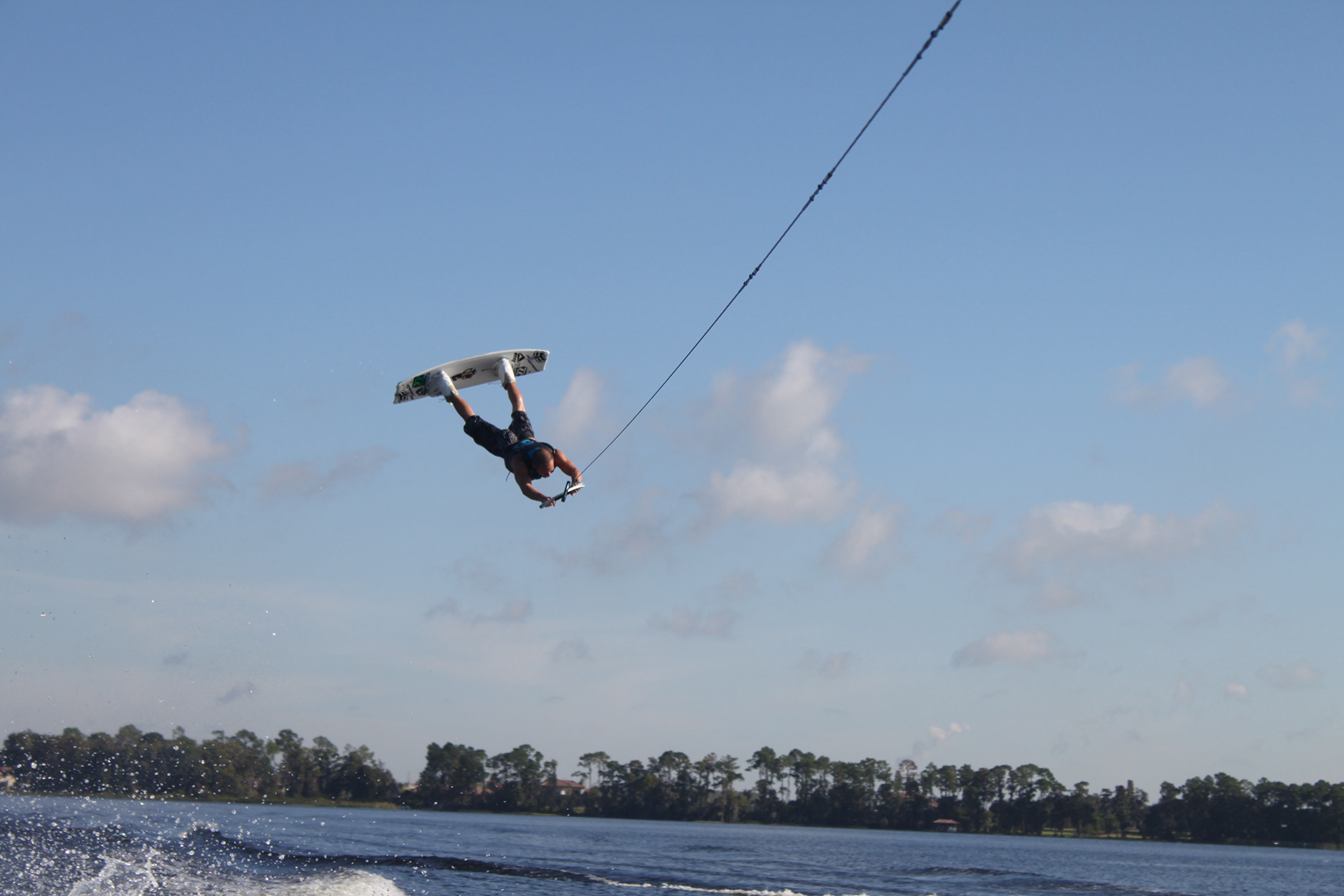
Canadian world champion wakeboarder Rusty Malinowski is testing the ShadowBox here at his home lake in Orland, FL. Becoming a legend in the process, Rusty was the first person to land a 1080 jump behind the boat.
Early on in the development of the ShadowBox, it was all about testing. Through this, we worked with multiple, top athletes to put the ShadowBox through its paces (see Jamie Pierre, world record holder for highest cliff jump on skis). One of the key opportunities we had was at the Utah Olympic Park, specifically working with Troy Flanagan (see athletes), the Director of High Performance & Director of Sport Science for U.S. Ski & Snowboard Association. Troy naturally took a special interest in our device because gathering and leveraging athlete data to stay healthy and gain a competitive edge was his primary mission. Now the Vice President of Performance at the Milwaukee Bucks in the NBA (go Damian Lillard!), Troy has spent over 20 years directing the sports science and medicine programs for various Olympic and Professional sports teams. Getting to know Troy was a special honor and he had a firm influence on how we planned to approach new sports for ShadowBox, including skiing, snowboarding, and more.

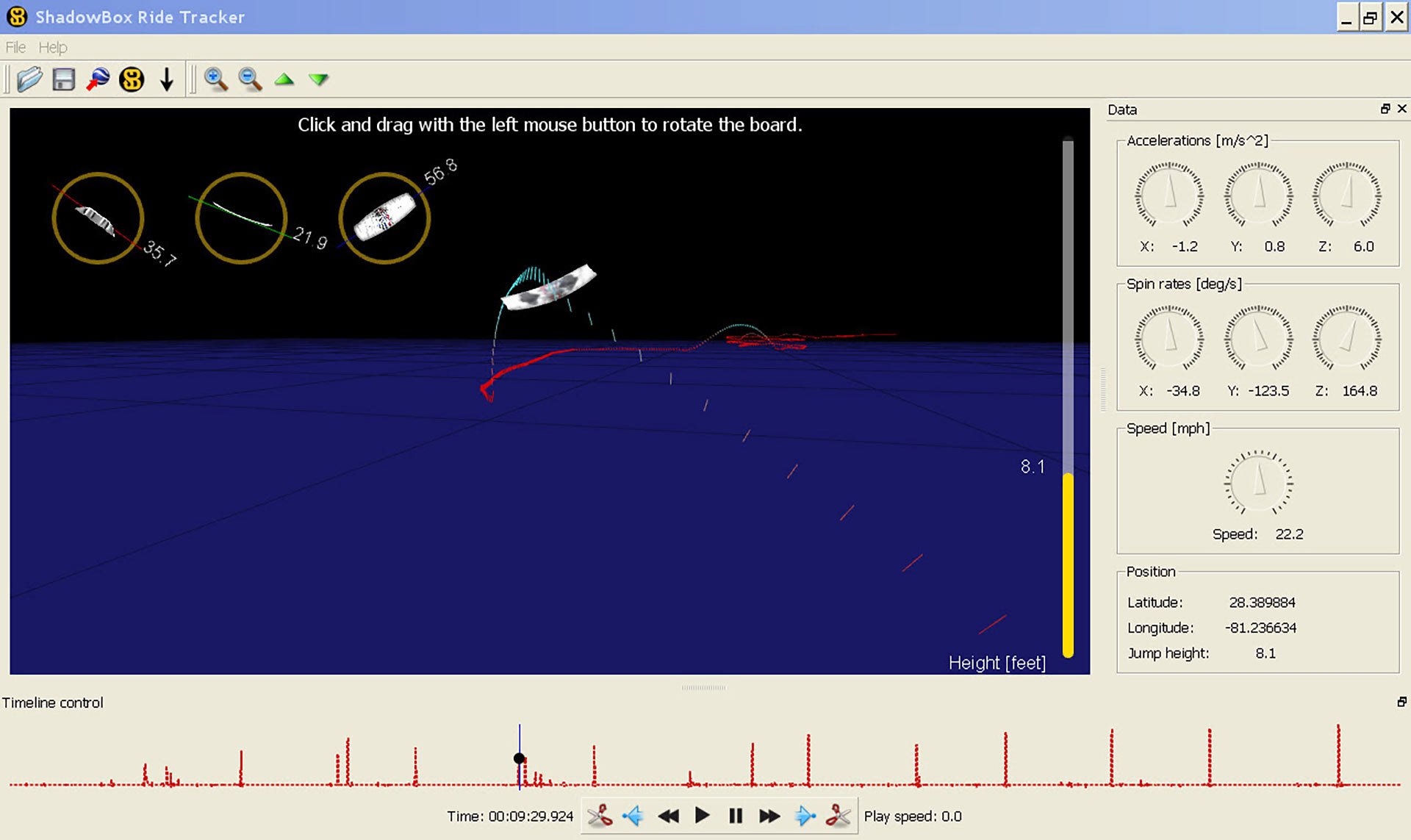
The Ridetracker program that took recordings from the ShadowBox and allowed users to see their ride on playback, complete with jump heights, path, acceleration, spin rates, speed, and Lat/Long.
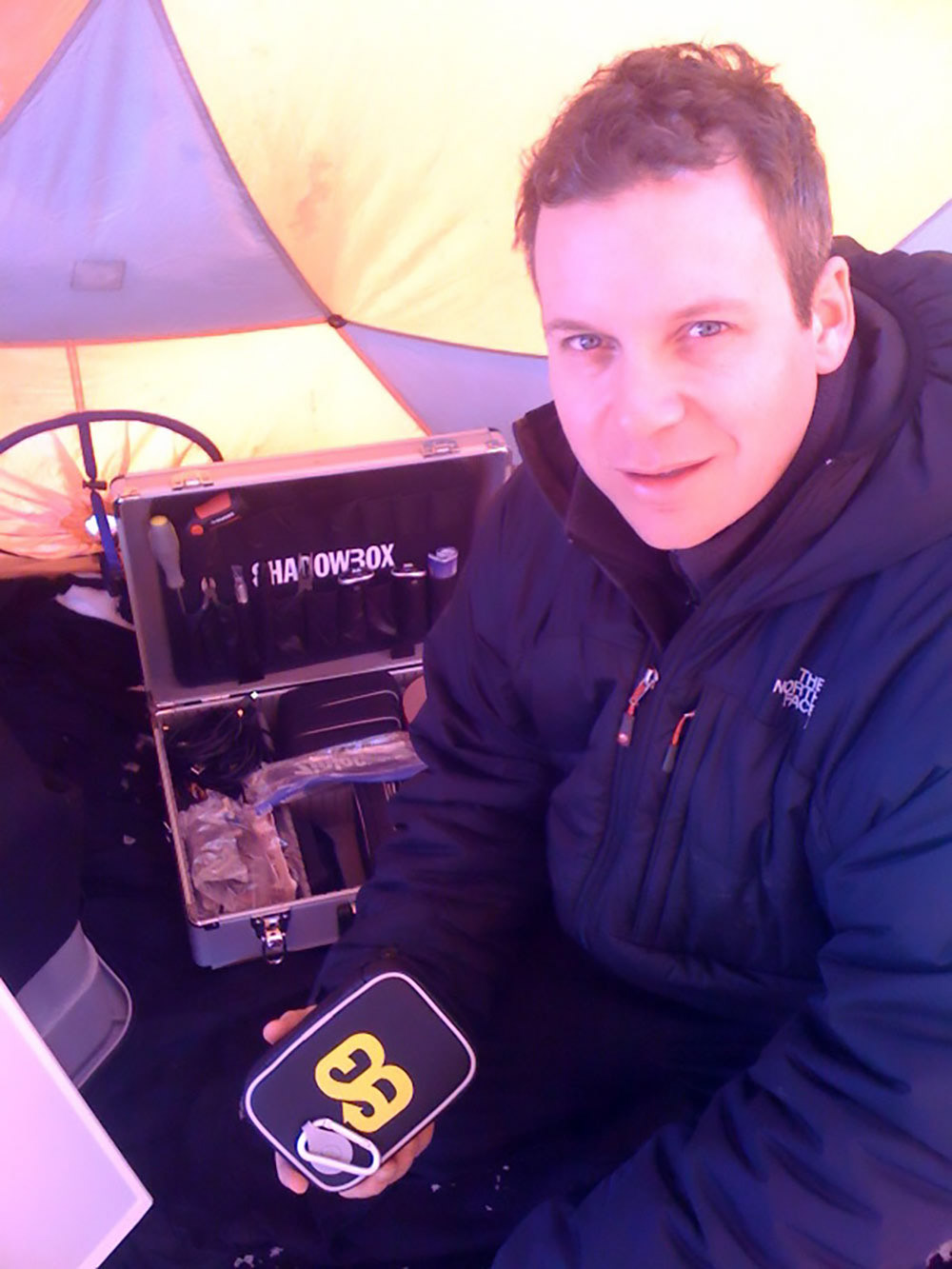
Yours truly holding a ShadowBox (in its case) while out judging a Snowkiting Big Air event in Utah. The box worked flawlessly in yet another, unanticipated sport and environment.
I got to work closely with Best Kiteboarding's Jacob Buzianis on a few different levels. First, Jacob was a competitor at a snowkiting event we had been invited to judge. We were onsite, fitting ShadowBoxes onto snowkite boards, and people were launching off of kickers to log the biggest jump. And while this event was cool, it was what was happening outside of the contest zone, on the backside of the mountain. Jacob Buzianis invited me back there and I watched as he raced down a face, boosted, and sailed completely across an entire canyon...easily 1000 feet. The biggest air we'd logged during the comp was 37 feet! This guy? He went hundreds. The data off the box was astounding. Thereafter I was connected with Jacob, supplying him with gear to test and getting excellent feedback. Jacob sent me some particularly amazing data sets from Alaska, where he, once again, was jumping canyons.
__________________________________________________
Wrapping up the Box
The time with ShadowBox, while fairly brief (2 years), was amazing. We were early in our launch and were re-tooling from v1.0 to consider a wider, mass-market play. I got the chance to work with countless brands across wakeboarding, windsurfing, kiteboarding, snowboarding, skiing, ice skating, and more. Thus, deep in our discussions was what sports to optimize the box for. With the box capturing basics physics "dope" on just about anything you attach it to, the question of the best target was a tricky one. We had so many opportunities and so much potential. In some ways, it was the team getting pulled in so many directions that led to its vulnerability and eventual downfall. An outside investor came in, plucked our key engineer, and poof it was gone. Yet here again, I had something in the wings. As an avid SCUBA diver, surfer, and outdoor adventurer living in Oregon where the water is cold and lacks tropical color, I wanted to build an indoor adventure theme park that would make one feel like they'd flown to the South Pacific. This was somewhat like bringing the original Surfer's Paradise game to life as all of my favorite sports were to be represented there. Here began my efforts to build the Fiji Adventure Sports Park just a stone's throw from Intel's main campus in Hillsboro, Or.
__________________________________________________

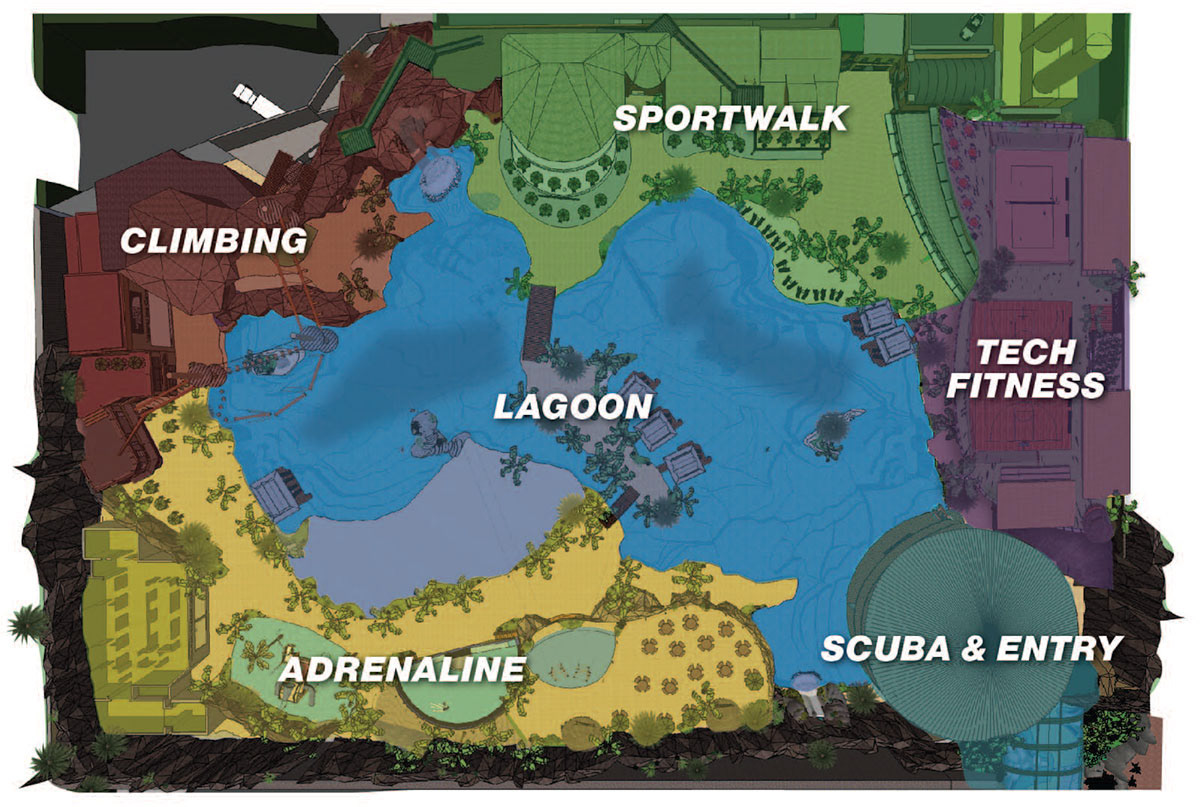
The Fiji Adventure Sports Park (see Inventions and Patents). These six zones captured all an adventurer might need on a rainy day in Oregon. Image Credit: Dan Meyers

Early on in the concept development phase of the Fiji Adventure Sports Park, I knew that getting a large construction developer onboard would be key for legitimacy and influence. I contacted Hoffman Construction Co. in Portland, Oregon, and built a presentation offering them the chance to be the lead developer in exchange for assistance with concept development, particularly in costing and feasibility. Hoffman saw the huge potential in developing a 90-acre theme park, recognized the need for it due to our eight months of rough weather, and signed on. I worked with Hoffman for several years, gaining their perspective and help in fleshing out what it would take to make it all happen. Talk about an education!
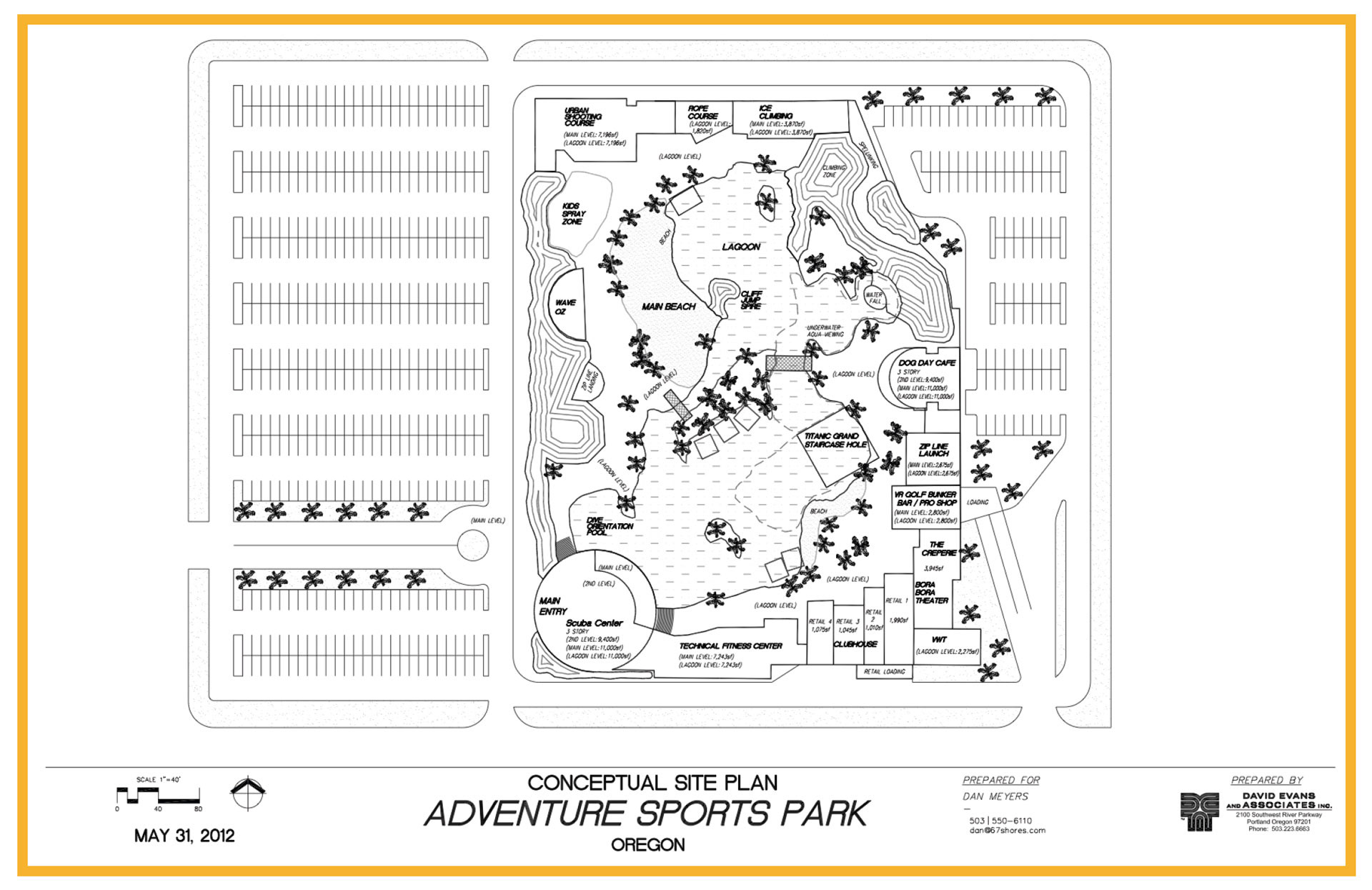
After getting Hoffman Construction Co. onboard, and through their introduction, I set up a meeting with David Evans and Associates, one of the top large development architectural firms in the Northwest. Like Hoffman, David Evans & Associates jumped in and began lending their expertise pro bono, all on the condition of being a part of the project should we secure proper funding. In particular, I became friends with architect Gill Williams, who took a special interest in the project, even traveling with me to Phoenix, AZ, to explore aspects of building large pools with rocks. This experience was a great education as well. David Evans created our first site plan, pictured below, and helped open even more doors for us.
With SCUBA diving a central feature at Fiji/Tahiti I wanted to get PADI involved onsite. The goal was to have a PADI 5-star dive center offering classes ranging from 1st-timers to advanced including night dive and deep dive certification. I made a trip to PADI's headquarters in San Clemente and found a very receptive crowd. PADI officials saw the clear chance for growing their sport and doing something truly unique within our park. PADI signed on to be a part of it all. 
Thinking that PSU's MBA program could be a good fit for getting some extra muscle in evaluating the Fiji project, I signed up to have the project included in their curriculum. A team of five graduate students was assigned to us and spent the next six months developing their analysis and feasibility study of the project. Some of the ideas the students came up with were very interesting and helped tighten our financials. However, the most beneficial aspect was the involvement of the professor, Dr. Kerry Sharp, who showed great interest in the project. Dr. Sharp signed on as our CFO going forward and worked with me to validate my assumptions in what is the largest set of financials I've ever built. I am still proud of those numbers, which were all based on a catchment argument for expected visitation and sponsor involvement.
_____________________________________________
I spent a total of three years working on the Fiji Adventure Sports Park project (2012-2015), mostly self-funding it. Serving as CEO, I secured multiple partners and spent three years working towards our goal, honing my 3D modeling skills in the process. Although we didn't overcome all the hurdles (turns out it is quite tough to build a theme park in Oregon), the experience was invaluable, providing insights and connections that would shape my career. Read more about the Fiji Adventure Sports Park in Inventions and Patents.
_____________________________________________
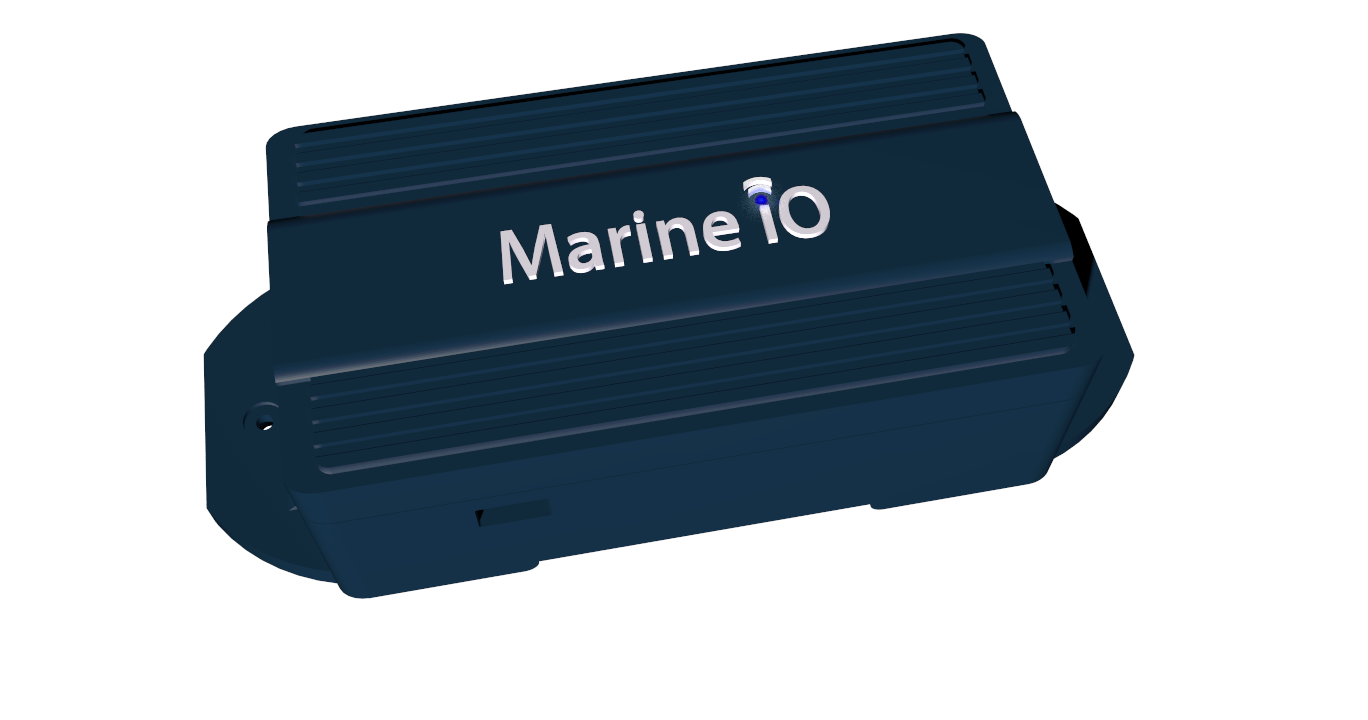
In 2015, Raleigh Murch, a software engineer at Asurion™—the largest electronics insurance company globally and a key Amazon partner—reached out to me. Along with his friend and fellow engineer Frank Maker, now VP of Technical Development at Roku, Raleigh had an innovative side project going called MarineiO. A true technical visionary, Raleigh remembered my brand management and 3D modeling expertise from our days at WakeKite (where he was one of our top team riders) and ShadowBox. MarineiO aimed to revolutionize the Maritime IoT space by mining engine data and integrating onboard sensors to provide insights, analytics, and vendor services via a platform for direct-to-consumer services like on-water towing, detailing, haul-out and storage, and dockside food delivery.
In the early stages of MarineiO, Raleigh invited me to join the team, leveraging my skills to help bring his and Frank's vision to life. Our efforts quickly attracted attention from Correct Craft™ and Indmar™, two of the largest boat and marine engine manufacturers. Indmar offered a $1 million investment, and they looked to be the ideal partner. As timing would have it, the buzz around our project reached asurion, which was launching a new skunkworks hardware initiative in Silicon Valley. Seeking to scoop us up, they offered prominent roles to both Raleigh and me, with me taking the job of industrial designer. Meanwhile, Frank Maker moved to a high-level position at Roku, eventually becoming their VP of Technical Development (nice job Frank!). This series of events marked a pivotal moment in our careers, blending the excitement of MarineiO's potential with invaluable opportunities at asurion. And while it would have been amazing to see MarineiO grow beyond the prototyping stage, asurion provided a platform for growth and experimentation that cannot be understated.

The prototype MarineiO housing that I built for testing. This unit was meant to connect to a boat engine, and needed to be rugged, obtaining an IP 56 rating for Ingress. Founder and CEO Raleigh Murch, now >>>> at LLL, was the brainchild behind the project and recruited Frank Maker and I to fill out the team.

In 2015 I landed a dream job with asurion™, which not only allowed me to secure and become proficient with two high-end 3D printers (one of which I still own) but also let me dive further into the world of hardware product design. Borrowing heavily from my work on the ShadowBox 3D Sports Recorder, my experience in the video game industry, the 3D work I did for the Fiji Adventure Sports Park, and MarineiO, I spent six years building functional electronic prototypes for asurion™. It was an amazing experience getting paid to model, 3D print, build electronics, and continually learn. Further, the team I was on at asurion was second-to-none. My boss, Jean-marc Parmentier, was (is) a total class act. Always giving credit where credit is due, and deep in the trenches with all of us, Jean-marc was as inspirational as he was talented. All bosses should be measured against JM! In any case, this was a fantastic job that was only ended by the pandemic, which led to the shutdown of asurion's hardware division in San Mateo, CA. Read more about my work with asurion in Industrial Design.
As a major partner of Asurion™, and in addition to my main job in the skunkworks hardware program, I was tasked with building several prototypes for customer phone-to-phone transfer stations for Sprint™. These stations would allow customers to transfer files and settings from their old phone to a new phone in the lobby, rather than waiting much longer for an employee to do it. Working with specs from Sprint was educational and allowed me to see into the design process for yet another Fortune 100 company. These brands have staying power for a reason.
_________________________________________
Transition to Consulting
After my tenure with asurion™, and with a broadened skillset spanning hardware design, prototyping, 3D modeling, branding, video production, and digital strategy, I made the decision to transition into consulting. This shift also aligned with my growing expertise in app development, vibe coding, and the emerging world of generative AI—particularly its use in film, animation, and sound design. I founded DM3 Consulting (Dan Meyers 3D) to offer a flexible, multi-disciplinary creative and technical service model for organizations seeking senior-level innovation without the overhead of a full in-house team.
My first major client, Portco Packaging, brought me in to support marketing across multiple fronts—blog writing, web development, video production, workforce training materials, photography, product storytelling, and brand strategy. As the top food-packaging manufacturer in the western U.S., Portco enabled me to work on projects connected to brands like Bob’s Red Mill™, Tillamook™, Alpenrose™, Beecher’s™, and C&H Sugar™.
Another long-standing client, Eyes on Broadway, has trusted me with full website management, ongoing blog development, and digital content strategy. Since modernizing their site and launching their content program, they’ve continued to earn recognition, winning the Willamette Week Readers’ Poll for Best Eyewear Shop ten straight years, including their 2025 win.
I also began working with Timberline Lodge and Mt. Hood Brewing Company, running social media strategy and producing a growing library of creative assets. These collaborations have become some of my most enjoyable engagements—combining photography, cinematics, AI-augmented video production, music curation, and storytelling to shape a distinctive brand voice across their digital platforms.
Over the last few years, I’ve built a specialty in AI-driven content creation workflows and micro-app development, using platforms like Make.com, n8n, and custom-coded environments to automate content generation, data processing, and creative production pipelines. This includes developing internal tools, interactive apps, and automated workflows that blend traditional development with vibe coding—rapid, AI-assisted prototyping that collapses weeks of engineering into days.
Parallel to this, I’ve pushed aggressively into generative AI filmmaking, using models like Kling, Runway, Veo, and hedra for animation, video, and character continuity. My current work includes AI-powered cinematics, digital doubles, scene-to-scene continuity, and AI-driven sound design, using tools like ElevenLabs, AudioCraft, and DSP-style diffusion models to create immersive, emotionally intelligent audio environments.
I’ve also served as a ghostwriter for Sappington, Microsoft’s premier external marketing agency, and partnered with STEELPORT Knife Co. on stop-motion videos and brand writing. STEELPORT remains one of the most exciting craft brands I’ve worked with—authentic, small-batch, and nationally recognized as the premier hand-forged chef’s knife made in the U.S. In addition, I produce dual newsletters for Oregon State University—one focused on AI, the other on semiconductors, helping the university communicate complex topics with clarity and depth.
Altogether, consulting has allowed me to combine the full spectrum of my career—brand strategy, technical storytelling, invention, product development, app creation, vibe coding, AI filmmaking, AI sound design, cinematics, and writing—into a unified, modern service that helps companies communicate powerfully, creatively, and with a competitive edge in an AI-driven world.
Explore my full career timeline on my Resume page.​​​​​​​
Back to Top